

Amaha / / / When Nothing Really Feels Exciting Anymore: Understanding Loss of Interest
ARTICLE | 6 MINS READ
When Nothing Really Feels Exciting Anymore: Understanding Loss of Interest
Published on
25th Aug 2026

Losing interest in things that used to feel worthwhile rarely arrives as a single dramatic moment. It tends to show up as a slow fading, a hobby quietly abandoned, plans made without enthusiasm, a sense that very little feels genuinely engaging anymore. This experience has a name in clinical psychology, and understanding it, along with what's actually driving it, is the first step toward addressing it rather than waiting for it to pass on its own.
What It Means to Lose Interest in Life: Anhedonia Explained
Anhedonia refers to a diminished capacity to feel interest or pleasure in activities that were previously experienced as rewarding. It's one of the two core symptoms required for a diagnosis of major depressive disorder under the DSM-5, alongside persistent low mood, though it also shows up as a feature of burnout, chronic stress, and several other conditions. Researchers distinguish between two components of anhedonia, a motivational component, reduced anticipation or "wanting" of pleasurable events, and a consummatory component, reduced actual enjoyment or "liking" once an activity is underway. It's typically the motivational component, the reduced pull toward things a person once looked forward to, that shows up first and most noticeably as "losing interest in life."
The Psychology and Neuroscience Behind Loss of Interest
Anhedonia is linked to reduced activity in the brain's reward circuitry, particularly regions involved in dopamine signalling that normally drive anticipation and motivation toward rewarding experiences. This helps explain why loss of interest often feels different from simple tiredness or low mood, since it specifically affects the wanting and anticipating part of experience rather than only the emotional response to it. Clinically, this is significant enough that anhedonia is increasingly understood as a distinct treatment target in depression, since some antidepressants that improve mood don't equally improve the capacity for interest and pleasure, which is part of why the two symptoms need to be tracked somewhat separately in recovery.

Lost Interest in Everything Lately?
Losing interest in what you once loved? Take a quick assessment to understand if it’s sadness or depression.
Common Signs Someone Has Lost Interest in Life
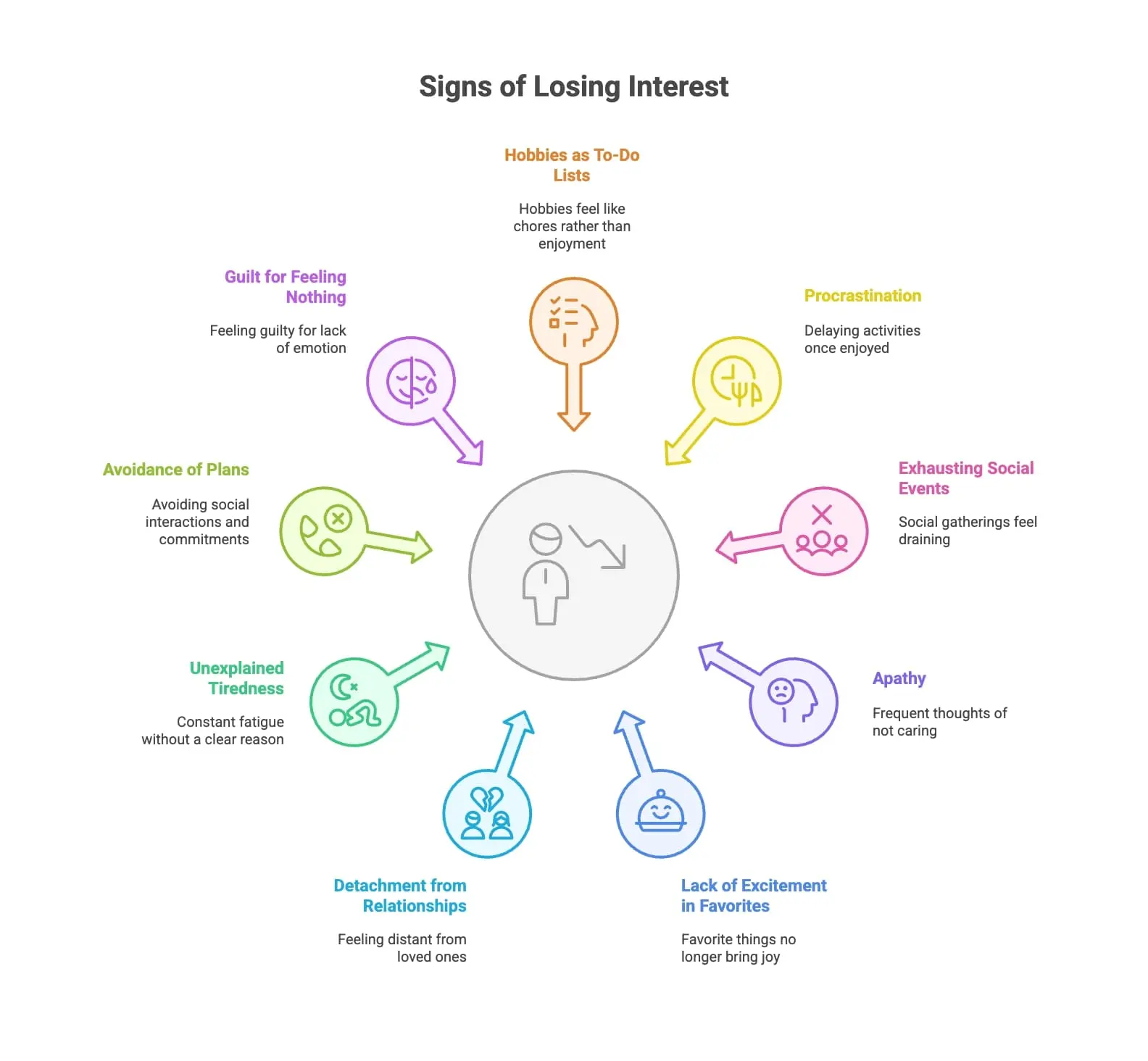
A handful of patterns tend to show up together when someone has genuinely lost interest in life rather than simply having a slow week. These include,
- no longer looking forward to previously enjoyed activities or plans
- a flattening of emotional response to both positive and negative events
- withdrawing from social contact not out of conflict but from a lack of pull toward it
- difficulty finding motivation for tasks that used to feel manageable
- a sense of going through the motions rather than genuinely participating in daily life
- reduced curiosity about things that once sparked it
- disrupted sleep or appetite
- a persistent sense of flatness or numbness rather than sadness specifically
- a noticeable drop in the effort put into appearance, hobbies, or relationships, not from a specific decision but because the motivation to maintain them has quietly gone
Loss of Interest vs Burnout vs Depression: Telling Them Apart
Burnout and depression share considerable symptom overlap, both can involve anhedonia, fatigue, and reduced sense of accomplishment, which is part of why they're often confused. The World Health Organization's ICD-11 classifies burnout specifically as an occupational phenomenon resulting from chronic, unmanaged workplace stress, characterised by exhaustion, cynicism or mental distance from work, and reduced professional efficacy, rather than as a medical or psychiatric diagnosis.
Depression, by contrast, is diagnosed clinically and isn't confined to a single life domain, affecting mood, interest, and functioning broadly rather than specifically in relation to work. A useful distinguishing question: does stepping away from the specific stressor, a holiday, a changed job, meaningfully restore interest and energy? With burnout, it often does, at least partially. With depression, low mood and loss of interest tend to persist even once the external pressure eases, which is one of the clearer signals that professional evaluation is warranted.
Root Causes Behind Losing Interest in Life
Loss of interest can stem from several overlapping sources.
- Chronic, unmanaged stress depletes the psychological and physical resources that sustain motivation and engagement over time.
- Unprocessed grief or loss, not always related to a death, can also include the loss of a role, a relationship, or a former version of one's life, can flatten interest in activities that once felt meaningful.
- Prolonged periods without adequate rest, meaningful social connection, or a sense of purpose or progress can produce a gradual drift into anhedonia even without a single identifiable trigger.
In some cases, loss of interest is the earliest visible sign of a depressive episode developing, appearing before mood changes become obvious even to the person experiencing it.

Get 15% OFF on First 3 Sessions - Use Code: FIRST15
Therapy works best when it’s approached with consistency. Take those first few steps with confidence, so you can begin your mental health journey. **Limited Period Offer
Loss of Interest in Everyday Indian Life: Family, Work, and Unspoken Pressure
In many Indian households and workplaces, a gradual loss of interest in life is easy to overlook or misattribute, since a person can continue fulfilling family and work obligations, showing up, performing tasks competently, even while genuinely disengaged internally. Family and workplace cultures that value stoicism and continued functioning over emotional disclosure can mean this pattern goes unnamed for a long time, dismissed as "just being tired" or "going through a phase" rather than recognised as anhedonia. Long-standing social expectations around career and marriage milestones can also mean a person continues performing the motions of a full life, working, socialising, attending family events, while privately experiencing very little genuine interest or pleasure in any of it, a disconnect that's easy to conceal precisely because it doesn't disrupt daily obligations the way more visible symptoms might.
How Loss of Interest Affects Work, Relationships, and Physical Health
At work, anhedonia tends to show up as reduced initiative, difficulty engaging with tasks that once felt satisfying, and a general sense of going through the motions rather than genuine investment.
In relationships, reduced interest in shared activities and social connection can be misread by a partner or family member as disinterest in the relationship itself, when it more often reflects a broader flattening that isn't specific to any one person or context.
Physically, anhedonia frequently travels alongside disrupted sleep, appetite changes, and lowered energy, and prolonged anhedonia has been associated with worse outcomes across mental health conditions more broadly, underscoring that it isn't simply a mood inconvenience but a symptom with real functional weight.
Practical Ways to Rebuild Interest and Motivation
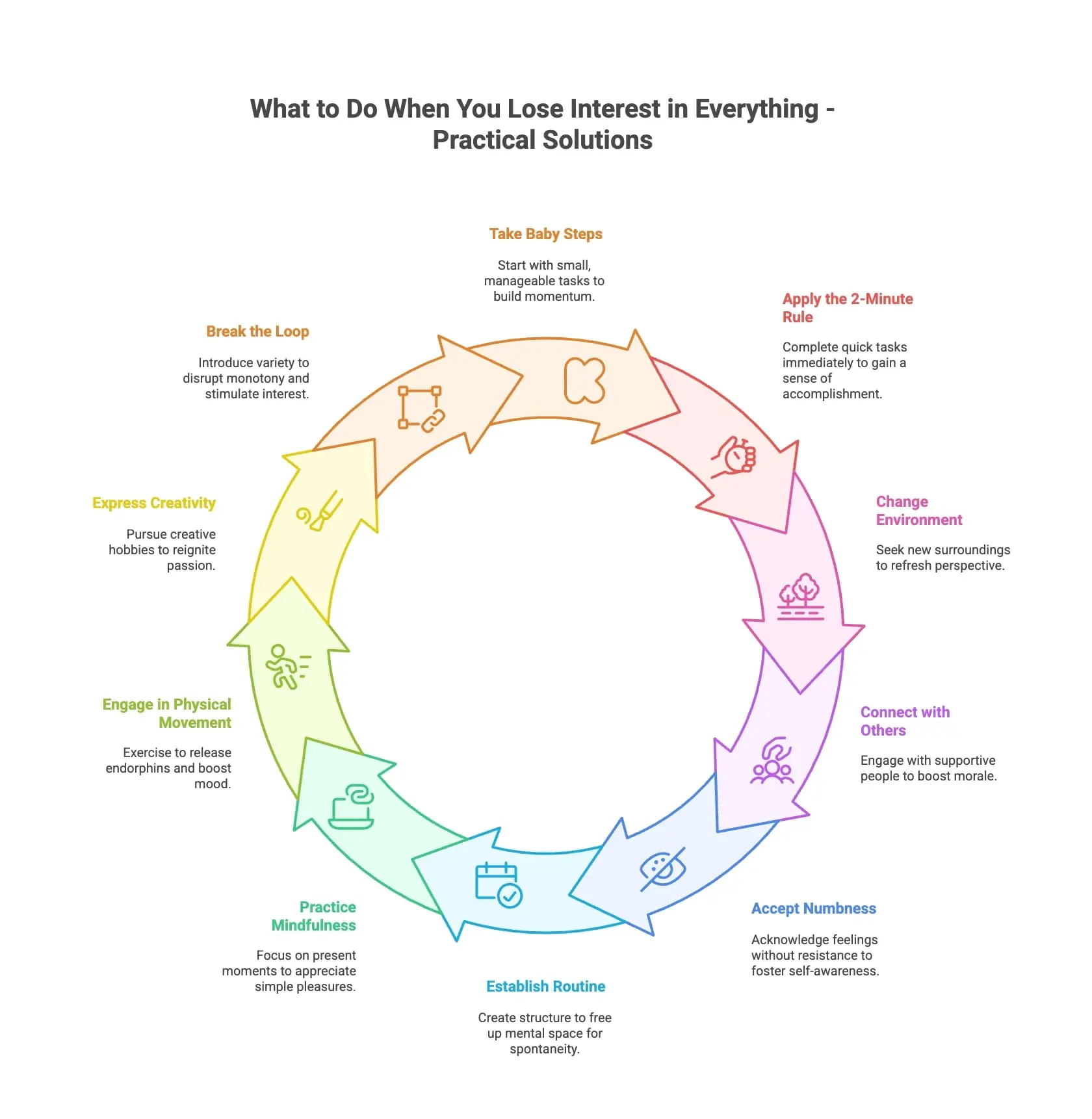
Rebuilding interest tends to work better through small, low-pressure re-engagement than through forcing enthusiasm for a previously loved activity all at once.
- Behavioural activation, deliberately scheduling activities regardless of whether motivation is present beforehand, is one of the more evidence-supported approaches, since waiting to feel motivated before acting often means waiting indefinitely, while acting first frequently generates at least some of the motivation retroactively.
- Reconnecting briefly and consistently with people, even without much enthusiasm for it initially, tends to work better than waiting until socialising feels appealing again.
- Addressing basic physiological contributors, sleep, movement, and nutrition, supports the same reward circuitry involved in anhedonia, even though it rarely resolves the underlying issue alone.
A Therapist's Perspective on Rebuilding a Sense of Purpose
Persistent loss of interest that doesn't lift with rest, a changed routine, or time away from an identifiable stressor is worth bringing to a therapist or psychiatrist, particularly if it's accompanied by low mood, sleep or appetite changes, or a general sense of numbness lasting more than a couple of weeks. A clinician can help distinguish burnout from a depressive episode, since the treatment approach differs meaningfully between the two, and can support a structured, gradual return to engagement rather than leaving someone to wait for interest to return on its own, which for genuine anhedonia often doesn't happen without some form of active support.

Feeling like you've Lost all the Spark of Life you once had
Speak to our Coaches about How Amaha can help you feel engaged with Life
Frequently Asked Questions
Q1: Is losing interest in everything a sign of depression?
While loss of interest can be a symptom of depression, it's not always indicative of clinical depression. It could be due to stress, burnout, life transitions, or other factors. However, if this feeling persists for more than two weeks and significantly impacts your daily life, it's worth consulting a mental health professional.
Q2: How long does it take to regain interest in things you once enjoyed?
The timeline varies greatly depending on the underlying cause and individual circumstances. Some people may start feeling better within a few weeks of making lifestyle changes, while others might need several months, especially if therapy or other interventions are involved. The key is to be patient and consistent with your efforts.
Q3: Can medication help with losing interest in everything?
In some cases, medication may be helpful, particularly if the loss of interest is related to depression or other mental health conditions. However, medication should always be prescribed and monitored by a qualified healthcare professional. Many people find that a combination of therapy, lifestyle changes, and sometimes medication works best.
Q4: What's the difference between normal boredom and pathological loss of interest?
Normal boredom is temporary and situation-specific - you might be bored with your current job or routine but still enjoy other activities. Pathological loss of interest affects multiple areas of life simultaneously and persists even when you try to engage in previously enjoyable activities. It's often accompanied by other symptoms like fatigue, changes in sleep or appetite, and difficulty concentrating.
Q5: Should I force myself to do things I've lost interest in?
Gentle encouragement is helpful, but forcing yourself can backfire and increase feelings of failure or frustration. Instead, try the "small steps" approach - commit to just 5-10 minutes of an activity without pressure to enjoy it fully. Sometimes action precedes motivation, and gradually increasing engagement can help rebuild interest naturally.