

Amaha / / / What is the Meaning of Situationship? Science and Signs
ARTICLE | 4 MINS READ
What is the Meaning of Situationship? Science and Signs
Published on
14th Jan 2026

Flora Grace Stanley
MSc Counseling Psychology

Many young Indians in metro cities have been in at least one situationship by their mid-twenties. Yet, we barely talk about it. Why? Because admitting you're in romantic limbo feels embarrassing, almost like confessing you've failed at the "relationship game." But you haven't failed at anything. A situationship isn't a relationship deficiency; it's a response to our generation's fear of commitment, meeting our deep need for connection. It's the emotional equivalent of keeping one foot in and one foot out.
What Exactly Is A Situationship?
A situationship is that complicated space where you're seeing someone regularly, maybe even intimately, but there's no label, no commitment, and definitely no conversation about where things are headed. You're doing things a couple would do without being a couple. Confusing? Absolutely.
Think about it. You text each other goodnight. You've met their flatmates. You know their coffee order by heart. But when someone asks, "So, are you two dating?" you freeze. Because honestly, you don't know.
It's more than casual dating but less than a committed relationship. The lines are blurry, intentionally so. Nobody wants to have "the talk" because that might mean ending what little they have.
Psychology And Science Behind Why Situationships Happen
Our brains are wired to seek connection, but modern life has complicated this basic human need. When you're in a situationship, your brain releases dopamine (the feel-good chemical) during your interactions, keeping you hooked. Yet, the uncertainty triggers cortisol (the stress hormone), creating an addictive cycle of highs and lows.
Attachment theory explains this brilliantly. People with anxious attachment styles often find themselves stuck in situationships, desperately wanting more but afraid to ask. Meanwhile, those with avoidant attachment styles might prefer this arrangement because it offers intimacy without the "pressure" of commitment.
The prefrontal cortex, which handles decision-making and future planning, actually shows reduced activity when the individual is stressed due to the anxiety or frustration that arises from a situation. Translation? You're literally thinking less clearly about whether this situationship serves you.
In relational-science terms, if you examine the classic triad of intimacy, passion and commitment (Triangular Theory of Love), situationships might have intimacy and passion but very little (or no) commitment.

Get Flat 15% Off on First 3 Sessions - Limited Time Offer*
Are you frustrated in finding yourself in Situationships again and again that lead nowhere? Speak with Our Experts to Understand and Break the Pattern

Why Do People Get Into Situationships? Reasons & Causes
Many enter a situationship because they're not ready to commit to a relationship and add to various pressures of ongoing everyday life, from career to family. The pressure to find the "right" person, someone who ticks all the boxes (good family, stable job, right community), makes people hesitant to label relationships that don't fit traditional moulds.
Career uncertainty plays a huge role, too. When you're grinding through your twenties and early thirties, focusing on that promotion or switching jobs, commitment feels like a luxury you can't afford. A situationship offers companionship without the "distraction" of a serious relationship.
Fear of rejection is another big one. By never defining things, you protect yourself from the pain of being officially turned down. It's safer to exist in ambiguity than risk hearing, "I don't want a relationship with you."
Some people genuinely believe they're just "going with the flow," not realising they've been flowing in circles for months. Others are still healing from past relationships and aren't ready for something real, though they won't admit it.
Other reasons:
- Fear of commitment or fear of losing freedom
- Past relationship trauma, so the label is avoided
- Wanting companionship and physical intimacy without long-term baggage
- The other person explicitly or implicitly says, “I’m not ready for a relationship”
- Cultural factors: in Indian urban settings, where meeting via apps or social circles happens, the line between friends, dating and serious relationships gets blurred
What Does A Situationship Actually Look Like? Characteristics Of A Situationship
1. No future planning. You make plans for next weekend, maybe next month. But talk about long-term plans? Never. There's an unspoken agreement to live in the present only.
2. Inconsistent communication. Some days, you're texting constantly. Other days, nothing. And you can't complain because, well, what are you to each other anyway?
3. Physical intimacy without emotional depth. You might be sleeping together, but conversations about feelings, fears, or vulnerabilities? Those remain off-limits.
4. You're not meeting their close circle. Or if you do, you're introduced as "my friend" with that awkward pause before the word "friend."
5. Everything's on their terms. Plans are made out of convenience and not with planned effort," not directing the convenience to either partner, it can be one or both.
6. You feel uncertain whether you are exclusive. On one hand, you feel special, on the other, you feel invisible. There’s no formal discussion about us or where this is heading.
Are There Any Advantages Of A Situationship?
Situationships can serve a purpose, temporarily. You get closeness and intimacy without full commitment, which can feel freeing. You can focus on your personal growth, career, studies, and still have someone. For some, it’s a low-pressure way to “test” a connection without jumping into a relationship. Especially in Indian urban life, where marriage and long-term planning feel far away, a situationship might feel appropriate for a phase.

Negative Effects And Impact Of A Situationship
1. Emotional burden: You're constantly anxious, overanalysing every text, every cancelled plan, every subtle shift in their behaviour. This anxiety affects your sleep, your work, and your other relationships.
2. Self-esteem drops: When someone won't commit to you, you start questioning your worth. Am I not good enough? What's wrong with me?
3. Love or confusion: If you want more, but the other doesn’t, you’ll feel hurt and anxious.
4. Mental health impact: The ambiguity and lack of security can lead to stress, frustration, identity issues and even depression.
5. Wasted time: You might invest months or years without progression; there’s a lack of clarity for those looking to get married or those considering it.
6. One-sidedness: If you want a relationship and the other party does not, you’re stuck.
7. No Meaning and direction: Difficult to turn into something meaningful if you don’t address the label and commitment part.
8. Uncertainty: creates something called "ambiguous loss," a psychological state where you're grieving something that's still present. You haven't lost the person, but you also don't really have them. It's exhausting.
There's also the practical impact. You're emotionally unavailable to others because you're hung up on someone who won't choose you.
Situationship vs Friends With Benefits (FWB): What's the difference?
This confuses a lot of people. Friends with benefits is typically clear from the start, it's primarily physical with friendship as the base, and there's usually mutual understanding about what it is and isn't.
A situationship is murkier. There are often genuine feelings involved (usually from at least one person). There's an illusion that this might become something more. The emotional investment is higher, and the boundaries are undefined.
With friends with benefits, you can often date other people openly. In a situationship, there's this weird territorial thing where you're not officially together, but the idea of them seeing others makes you sick.
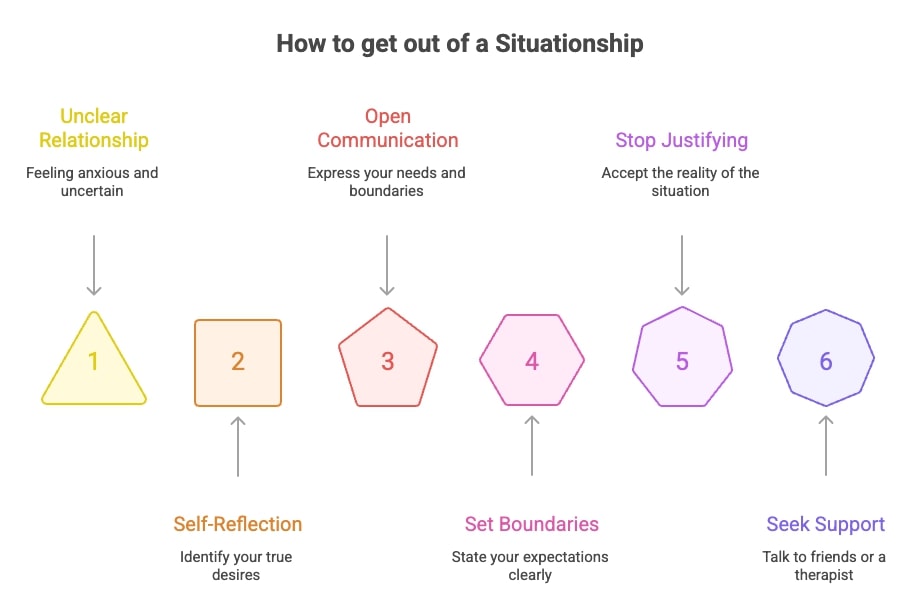
How Do You Get Out Of A Situationship?
- Get honest with yourself: What do you actually want? Not what you think you should want, not what your friends say, but genuinely, what would make you happy?
- Real conversation: Have the talk you've been avoiding. Yes, it's scary. Yes, they might not react well. But staying silent is choosing continued anxiety over temporary discomfort.
- Set boundaries: If you want exclusivity or a label, state it. If you don’t get it, walk away.
- Stop justifying: Don’t keep hoping “maybe it’ll change. Action matters.
- Seek support: Talk to a friend or a therapist, especially if patterns repeat.
- Rebuild: Focus on self-worth, your goals, and your circle. You deserve clarity.

Need help deciding your next step?
Talk to a trained clinical coach to understand what you’re experiencing and explore suitable mental health care support options.
Key phrases you can use to initiate the talk:
- Say something like: "I've been thinking about where we're at, and I need more clarity. I'm interested in a committed relationship. If that's not what you want, I need to know so I can make decisions that are right for me."
- “I really value what we share… but lately, I’ve been wondering where we’re headed.”
- “You mean a lot to me, and I just want to understand what this is for you.”
- “I don’t want to sound heavy, but clarity helps me feel safe — can we talk about where this is going?”
- “Can I share something that’s been on my mind lately?”
- “I think we both deserve clarity, even if it’s a difficult conversation.”
Notice you're not begging or demanding. You're stating your needs and giving them space to respond honestly.
If they're vague, that's your answer. "I don't know," "Let's see where things go," or "Why do we need to label it?" are all versions of "no."
Once you know they don't want commitment, you have to be brave enough to walk away. Block if necessary. Delete their number. Remove them from social media. This isn't dramatic; it's self-preservation.
How To Turn A Situationship Into A Relationship
Yes, you can turn it into something more, but it takes work.
- Firstly, the conversation: “What are we? Where is this going?” In India, this might mean meeting families if that is culturally relevant.
- Shared plans: If both agree, start making shared future-oriented plans (even small ones).
- Align expectations: Are you both open to exclusivity and commitment? If yes, fine. If not, walk away.
- Build trust and stability: Being consistent, open, and reliable.
- Re-label: Transition from “we’re hanging out” to “we’re in a relationship”. That label matters in social/ family contexts in India.
If you find the other person still unwilling, you must ask: am I okay with staying as is? If not, moving on is valid.
Are Situationships Actually Healthy?
For most people, most of the time? No.
They create emotional instability, erode self-worth, and prevent you from finding genuine connection. The anxiety they generate affects your overall well-being.
There are exceptions. If both people are genuinely happy with the arrangement, have clear communication, and aren't secretly hoping for more, it can work temporarily. But that's rare.
The problem is dishonesty, usually with yourself. You tell yourself you're fine with it whilst secretly checking your phone every five minutes, hoping they've texted.
How Can Therapy Help In Avoiding Or Repeating Situationships?
If you find yourself repeatedly entering situationships, it's worth exploring why with a therapist. Often, these patterns point to deeper issues: fear of intimacy, low self-worth, unresolved trauma from past relationships, or attachment issues stemming from childhood.
A good therapist can help you identify these patterns and understand their roots. They'll work with you on building self-worth that isn't dependent on romantic validation, setting and maintaining healthy boundaries, recognising red flags earlier, and communicating your needs clearly.
If you find yourself repeatedly in situationships and wondering, “Why do I always end up here?”, therapy can help. Here’s how:
- It helps uncover your attachment style (are you avoidant? anxious?).
- You learn communication skills: how to express what you want, how to ask for clarity.
- You address patterns: e.g., always choosing unavailable people, or avoiding commitment yourself.
- You build self-worth: You’ll start believing you deserve clarity, respect, and commitment.
- Especially in the Indian context, where stigma around therapy still exists, working with a qualified therapist (certified in India) can be a powerful step.


How healthy are the patterns in your relationship?
Take the assessment to explore patterns in attachment, communication, and conflict.
Frequently Asked Questions About Situationships
How long do situationships usually last?
They typically end when one person wants commitment or meets someone else. The ambiguity makes them emotionally unsustainable long-term for most people.
Is being in a situationship always a sign of a fear of commitment?
Not always. Sometimes it’s mutual, sometimes one person is fine with the status. But often, fear of commitment plays a part.
Can two people be in a healthy situationship?
Yes, if both agree, both understand, both are comfortable with no label, no long-term expectation. Honesty is the key.
Do guys catch feelings in situationships?
Absolutely. Men develop feelings in situationships just like women do, though they might express or acknowledge them differently due to social conditioning. The myth that men don't get emotionally attached in casual arrangements is simply untrue.
Does a situationship count as “dating”?
Technically, yes, you may date, hang out, and connect, but it lacks the clarity and intention of a committed relationship.
What’s the first sign it’s time to end a situationship?
One sign could be that you’re the one wanting more (future, commitment, label), and the other isn’t; you feel anxious often, your self-esteem dips—that’s a red flag. Another sign could be increasing levels of frustration and irritability, or trying to come up with excuses to avoid meeting the other person for anything that involves emotional vulnerability.