

Amaha / / / Understanding Different Types of Trauma: A Journey Through Mental Wounds and Healing
ARTICLE | 6 MINS READ
Understanding Different Types of Trauma: A Journey Through Mental Wounds and Healing
Published on
30th Dec 2025

Shruti Rajan Kappil
M.Sc., M.Phil in Clinical Psychology

While global data suggests that nearly 70% of people experience at least one traumatic event in their lifetime, studies in India indicate a particularly high prevalence of adverse childhood experiences. In a society where mental health is often discussed in hushed tones, recognising trauma is the first step toward collective healing.
Trauma is not defined by the event itself, but rather by the internal response to that event. It occurs when an experience overwhelms an individual's ability to cope, fundamentally altering how they perceive themselves and the world. Rather than a "malfunction," trauma is a profound adaptation, the brain’s way of prioritising survival after its sense of safety has been shattered.
What Exactly Is Trauma?
At its core, trauma is an internal injury to the nervous system. While we often think of trauma as a specific "event” like an accident or a loss, it is more accurately defined by the lasting impact that event has on your mind and body.
Trauma occurs when an experience is so overwhelming that it bypasses your normal ability to cope. Instead of processing the event and moving on, your brain gets "stuck" in a state of high alert. It is the psychological equivalent of a physical wound that hasn’t been allowed to heal properly; even years later, the area remains sensitive to the slightest touch.

Are you tired of your past baggage and trauma affecting you?
Discuss the details with our Care Team who can guide you to get Rid of your Past Baggage
The Science Behind Trauma: How Our Brain Responds
When we encounter a traumatic event, our brain's internal hierarchy shifts. The amygdala, which acts as a smoke detector, becomes hyper-responsive, staying on high alert even after the danger has passed. Simultaneously, the prefrontal cortex, which is the rational "CEO" of the brain, often goes offline, making it difficult to use logic to calm ourselves down.
Trauma also impacts the hippocampus, the part of the brain responsible for filing memories with a "date and time" stamp. When this area is affected, traumatic memories aren't stored as past events; they feel as though they are happening in the present, which is what leads to flashbacks and chronic anxiety.
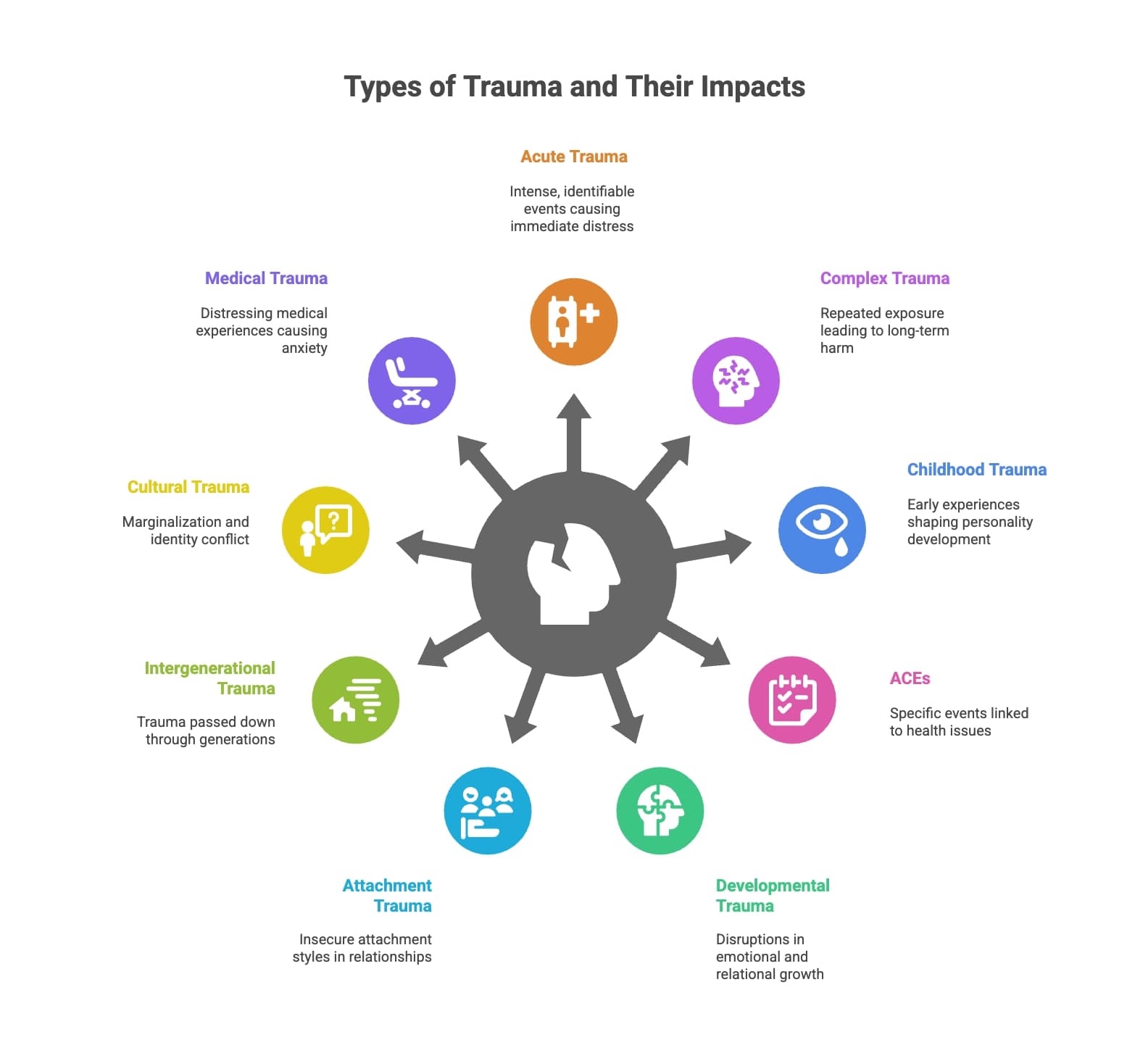
Types of trauma: the many faces of emotional wounds
Acute Trauma
This results from a single, high-impact event, such as a car accident, a natural disaster, or a sudden act of violence. Because there is a clear "before" and "after," acute trauma is often the most straightforward to identify.
Complex Trauma
Complex trauma arises from repeated, prolonged exposure to stressors, often where escape is difficult. In many Indian households, this may manifest as long-term emotional abuse or domestic volatility that is normalised as "strictness." Unlike acute trauma, complex trauma erodes a person’s sense of self over many years.
Childhood Trauma/ Adverse Childhood Experiences
Adverse Childhood Experiences (ACEs) are specific traumatic events, ranging from neglect to household dysfunction, that occur before age 18. Research shows that high ACE scores are statistically linked to chronic physical health issues in adulthood, such as heart disease and autoimmune disorders. In India, behaviours like physical punishment or emotional coldness are often dismissed as "building character," yet they are frequently the roots of adult psychological distress.
Attachment and Developmental Trauma
This occurs when a child's primary caregivers are inconsistent or frightening. It creates a "shaky foundation" for all future relationships. In cultures where emotional expression is discouraged, children may grow up feeling that they must earn love through performance or silence, leading to insecure attachment styles in adulthood.
Intergenerational and Cultural Trauma
Trauma can be passed down through family systems via parenting styles and unspoken anxieties. Even without direct experience, a person may carry the "emotional memory" of a family’s past displacement or community loss. Furthermore, cultural trauma can stem from identity conflicts, systemic discrimination, or religious environments that use fear as a primary motivator.
Medical Trauma
Hospital visits, surgeries, or chronic illness can create lasting psychological wounds. In India, where medical care can sometimes be impersonal or overwhelming, patients often develop anxiety around healthcare settings.
The four trauma responses
We often hear about "Fight or Flight," but humans have four primary ways of responding to a threat:
- Fight: Becoming aggressive or controlling to regain a sense of safety.
- Flight: Using busyness, workaholism, or literal avoidance to escape the pain.
- Freeze: Feeling paralysed, numb, or "spaced out" when overwhelmed.
- Fawn: This is common in Indian society and involves people-pleasing to appease a perceived threat. Many "good children" are actually trauma survivors who learned to ignore their own needs to keep the peace at home.
Types of trauma-related disorders
When we speak about the impact of trauma, we are often referring to a range of clinical diagnoses. Trauma doesn't always look like "shell shock"; it can manifest as emotional numbness, chronic irritability, or severe relationship difficulties.
1. Acute Stress Disorder (ASD)
This is the immediate psychological response following a traumatic event. ASD occurs within the first month after the trauma. Symptoms include a sense of detachment, "mental fog," and intense anxiety. If these symptoms persist beyond 30 days, the diagnosis typically shifts to PTSD.
2. Post-Traumatic Stress Disorder (PTSD)
PTSD is characterised by four main symptom clusters:
- Intrusive Memories: Flashbacks, nightmares, or intense physical reactions to reminders.
- Avoidance: Steering clear of places, people, or even thoughts associated with the event.
- Negative Changes in Mood/Cognition: Inability to remember parts of the trauma, persistent negative beliefs about oneself, or feeling detached from loved ones.
- Hyper-arousal: Being easily startled, feeling "on edge," or experiencing outbursts of anger.
3. Complex PTSD (C-PTSD)
While PTSD often results from a single event, C-PTSD is the result of prolonged, repeated trauma, such as childhood abuse, domestic captivity, or long-term neglect. In addition to standard PTSD symptoms, individuals with C-PTSD struggle with:
- Emotional Dysregulation: Severe "emotional storms" or prolonged periods of numbness.
- Negative Self-Concept: Chronic feelings of shame, guilt, or being "fundamentally broken."
- Relational Challenges: Great difficulty trusting others or maintaining stable boundaries.
Note on Diagnosis: While C-PTSD is not yet a separate diagnosis in the US-based DSM-5, it is officially recognised in the ICD-11 (the World Health Organisation's diagnostic manual used in India), providing a vital framework for treatment in the Indian clinical context.
4. Dissociative Disorders
For some, the pain of trauma is so great that the mind develops an "eject button" to cut off from experiencing that pain. Dissociation is a mental disconnect from one's thoughts, feelings, memories, or sense of identity. In severe cases, this can manifest as Dissociative Amnesia (forgetting periods of time) or Depersonalization-Derealization Disorder (feeling like the world is "fake" or you are outside your own body).
What types of trauma can cause PTSD?
Not all traumatic experiences lead to PTSD, but some are more likely to:
- Combat exposure
- Sexual violence
- Serious accidents
- Natural disasters
- Childhood abuse
- Witnessing violence
- Medical emergencies
- Terrorist attacks
The key factors? Severity, duration, and personal vulnerability. Someone with strong family support might recover faster than someone facing trauma alone. PTSD involves actual brain changes that require professional treatment. Read this to understand how you can identify and manage Post traumatic stress disorder.
Domains of trauma: where it shows up
Trauma doesn't stay neatly contained, it manifests in various forms and affects daily life in multiple ways.
Physical Domain: Chronic pain, headaches, digestive issues, sleep problems. Your body keeps the score, as they say.
Emotional Domain: Depression, anxiety, mood swings, feeling numb or overwhelmed.
Cognitive Domain: Memory problems, concentration issues, negative thought patterns.
Behavioural Domain: Addiction, self-harm, risky behaviours, or extreme avoidance.
Social Domain: Relationship difficulties, isolation, trouble with intimacy or boundaries.
Spiritual Domain: Loss of meaning, existential crisis, questioning beliefs.
Types of Trauma Therapy: Paths to Healing
Trauma-Focused Cognitive Behavioural Therapy (TF-CBT)
This helps people understand the connection between thoughts, feelings, and behaviours. It's like rewiring your brain's response patterns. TF-CBT can be particularly effective because it provides practical tools and homework assignments for self-help.
Eye Movement Desensitization and Reprocessing (EMDR)
By moving your eyes in specific patterns while recalling traumatic memories, the brain can process them differently. EMDR is gaining popularity in Indian cities as more clinicians get trained in the same.
Somatic Experiencing
This focuses on body sensations. In a culture where we're taught to ignore physical discomfort, this can be particularly helpful for Indians. The therapy helps people learn to listen to their bodies again - something many trauma survivors have lost the ability to do.
Narrative Therapy
Helping people rewrite their story. Instead of "I'm broken because of what happened," it becomes "I'm a survivor who's learned to cope." This approach resonates with Indian culture's emphasis on storytelling and finding meaning in experiences.
How therapy practically helps people struggling with trauma
Darshini was someone who couldn't sleep for months after being in a train accident. Following the train accident, she struggled with "time-travelling" memories -moments where her brain convinced her she was back in the wreckage.Through therapy, she learned grounding techniques, which are physical anchors used to pull someone out of a flashback and back into the safety of the present moment.
Therapy doesn't erase trauma. It teaches you to live with it differently. Like learning to walk with a limp - you're still walking, just with a different rhythm.
Practical benefits include:
- Better sleep patterns
- Improved relationships
- Reduced anxiety and depression
- Enhanced self-awareness
- Healthier coping mechanisms
- Increased emotional regulation
- Better stress management
- Improved self-esteem
The process isn't linear. Some days you'll feel like you're making progress, others you'll feel like you're back at square one. That's normal.
Resilience: what helps people recover
Not everyone who experiences trauma develops lasting problems. Some factors that promote resilience include:
- Strong social support
- Healthy coping strategies
- Meaning-making abilities
- Previous successful coping experiences
- Spiritual or religious beliefs
- Physical health and self-care
In India, our cultural emphasis on family and community can be protective factors, but only when these systems are healthy and supportive.
Recovery isn't about returning to who you were before. It's about integration - learning to carry your experiences while continuing to grow and live fully.

Community for Dealing with Trauma
Connect and Discuss with People going through similar concerns as yours
Frequently Asked Questions
Q1: What are the main types of trauma that affect Indians?
The most common types include childhood trauma (emotional neglect, physical abuse), cultural trauma (identity conflicts), intergenerational trauma (passed down from previous generations), and acute trauma from accidents or violence. In the Indian context, family-related trauma and societal pressure-related stress are particularly prevalent.
Q2: How do I know if I have trauma or just stress?
Trauma typically involves intense, overwhelming experiences that continue affecting your daily life long after the event. Unlike regular stress, trauma symptoms include flashbacks, nightmares, avoidance behaviours, and feeling disconnected from yourself or others. If you're experiencing persistent anxiety, depression, or behavioural changes after a difficult event, it might be trauma-related.
Q3: Can childhood trauma affect adults even decades later?
Absolutely. Childhood trauma can shape brain development and affect how we handle relationships, stress, and emotions throughout life. Many adults struggle with trust issues, self-esteem problems, or relationship difficulties that stem from childhood experiences. This is why addressing childhood trauma, even in adulthood, is crucial for healing.
Q4: What types of therapy work best for trauma in India?
Several evidence-based therapies work well for trauma, including Trauma-Focused CBT, EMDR, and somatic experiencing. In India, therapists often combine these with culturally sensitive approaches that consider family dynamics and social contexts. The key is finding a therapist who understands both trauma treatment and Indian cultural nuances.
Q5: How can family members support someone dealing with trauma?
Family support is crucial in Indian culture. Listen without judgment, avoid minimising their experiences, and educate yourself about trauma. Don't pressure them to "get over it" quickly. Instead, be patient, consistent, and supportive. Encourage professional help when needed and consider family therapy to address how trauma affects the entire family system.
Q6. What is the meaning of trauma in Hindi?
Trauma in Hindi is called "आघात" (aghaat), "मानसिक आघात" (maansik aghaat), or "सदमा" (sadma). It refers to deep psychological wounds or emotional injuries caused by distressing experiences that significantly impact a person's mental health, behaviour, and overall well-being.
Q7. हिंदी में ट्रामा का क्या मतलब है?
ट्रामा को हिंदी में "आघात", "मानसिक आघात", या "सदमा" कहते हैं। यह गहरे मानसिक घावों या भावनात्मक चोटों को दर्शाता है जो कष्टकारी अनुभवों से होती है और व्यक्ति के मानसिक स्वास्थ्य, व्यवहार और समग्र कल्याण को प्रभावित करती है।