

Amaha / / / Therapy Games In India: Healing Through Play
ARTICLE | 6 MINS READ
Therapy Games In India: Healing Through Play
Published on
3rd Apr 2026

Harsiddhi Thakral
M Phil In Clinical Psychology
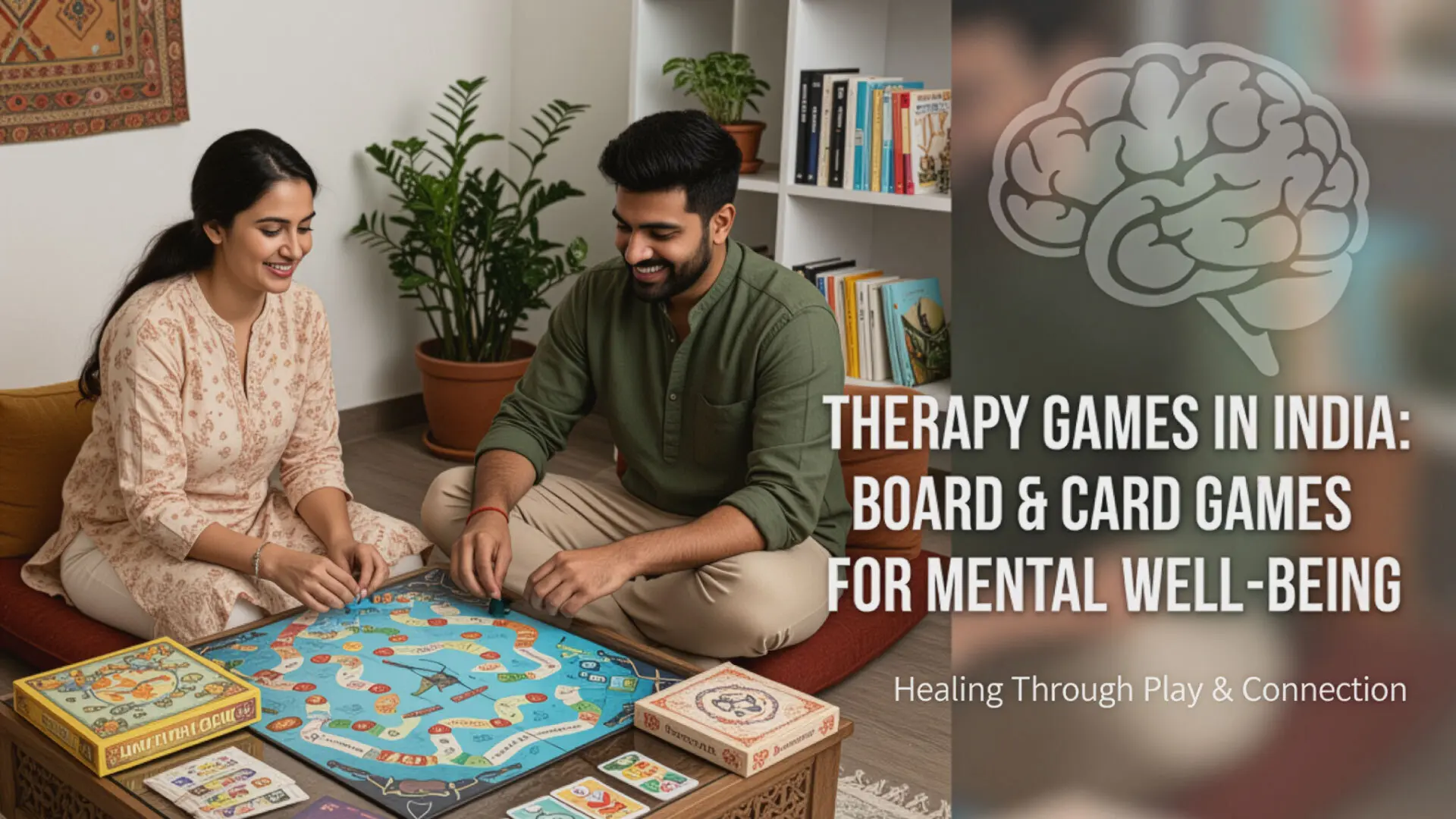
More Than Just A Game: Can We Play Our Way To Better Mental Health?
According to the World Health Organisation, India carries a significant proportion of the world’s mental health burden, and many people find direct, face-to-face conversations about their struggles difficult or intimidating. What if there were a way to begin addressing mental health in a gentler, more playful manner, alongside professional care when needed?
We often assume that board games are just for children or for special occasions, such as Diwali parties. However, when used intentionally, simple tools such as card games and board games can help people build skills, manage stressors, and support emotional well-being, particularly within therapeutic or guided settings.
What's The Science Behind These Therapy Games?
Therapy games involve far more than rolling dice and moving tokens. When people engage in games that feel enjoyable and rewarding, the brain’s reward system can be activated, which is closely linked to motivation and positive emotions. At the same time, participating in a structured and absorbing activity within a safe environment may help some individuals feel calmer and more emotionally regulated, especially when combined with supportive social interaction.
Directly discussing trauma, anxiety, or distress can often feel overwhelming. Therapy games offer a structured and engaging activity that gently shifts focus away from immediate stress, creating space to approach difficult topics more gradually. In this way, games provide a low-pressure environment to explore high-intensity emotions and experiences, usually as a complement to, rather than a replacement for, professional mental health support when needed.

Assess Your Mental Well-being
Take our quick assessment to understand if you are feeling sad or depressed, and explore how play-based therapy can help.
How Do Therapy Board Games Work?
Most therapy board games and therapy card games are built around prompts, questions, or scenarios. For example, a card might ask, “Describe a time you felt proud,” or a space on the board might prompt, “What is one thing you would like to change about your routine?”
These prompts serve two important purposes.
First, they reduce inhibitions. It is often easier to respond to a question drawn from a card than to answer a direct question from someone sitting opposite you.
Second, they guide the conversation. Rather than an unstructured or meandering discussion, the game provides a clear framework. Players follow the path, respond to prompts, and are gently guided towards reflection and dialogue.
For example, using a simple therapy card game with a family that struggles to communicate can make a noticeable difference. A teenager who is initially withdrawn may begin to open up when prompted to describe their ideal day, with the game providing a sense of safety and reduced fear of judgment.
Therapy Games: How Board Games & Card Games Are Revolutionising Mental Health Treatment In India
Some historians note that traditional Indian board games such as Chaupar and Pachisi may have encouraged strategic thinking and reflection alongside entertainment, although they were not therapy games in the modern clinical sense. Today, modern board and card games designed with therapeutic goals are gradually finding a place in Indian homes, schools, and clinics. Mental health professionals may recommend them as supportive tools to improve communication, emotional awareness, and coping skills.
Research on therapy games is still emerging, particularly in Indian contexts. Early reports and small-scale studies suggest that families who regularly use structured, conversation-focused games may notice improved communication and reduced perceived stress. However, more rigorous research is required. Rather than viewing therapy games as stand-alone treatments, it is more accurate to see them as one useful tool among many, ideally used alongside professional mental health care.
The Science Behind Therapy Games: More Than Just Fun
Therapy games work by engaging psychological processes that humans respond to naturally. When individuals participate in structured games involving social interaction and problem-solving, cognitive, emotional, and interpersonal processes are activated together. This can create positive associations with practising skills such as communication, planning, and emotional expression in a low-pressure setting.
Card games, in particular, can support working memory and cognitive flexibility, as players must hold information in mind and adapt to changing situations. The benefit lies in how these games create a “practice space” where therapy or skill-building is embedded within play, rather than feeling like an assessment or interrogation.
Emerging research suggests that board games and applied games can support social skills, emotional awareness, and health behaviours over time when used regularly and thoughtfully, often alongside other interventions. However, the evidence base is still developing, and most studies report small to moderate benefits rather than dramatic changes.
How Therapy Games Actually Work In Practice
The underlying mechanism is relatively simple. Therapy games create what game scholars describe as a “magic circle, a space in which everyday roles soften slightly and people feel safer experimenting with new ways of interacting.
When families sit together to play therapy board games, several therapeutic processes can unfold naturally. Participants may practise managing frustration when things do not go their way, develop communication skills while explaining their moves, and experience both success and failure in a supportive environment.
The structured nature of board games provides predictability, which anxious minds often find comforting. At the same time, elements of chance gently model the idea that some outcomes are beyond our control, an important life lesson when discussed and reflected upon.
Card games add another dimension by requiring players to conceal some information while interpreting others’ intentions. This can mirror real-life social situations and provide useful practice for reading social cues and taking different perspectives, particularly for individuals with social anxiety when used under guidance.
Benefits That Go Beyond The Gaming Table
Therapy games offer a range of potential benefits beyond entertainment, especially when facilitated by a therapist, caregiver, or teacher who can help link in-game experiences to everyday life. They are often easier to engage with than sessions that feel highly clinical, which may encourage some people to open up more freely.
Potential benefits include:
- Emotional regulation support: Regular gameplay can help individuals notice and practise managing emotional responses, such as disappointment after a loss or excitement after a win, within a safe environment.
- Enhanced communication skills: Board games naturally encourage discussion, negotiation, and expression of thoughts, providing frequent opportunities to articulate ideas and respond to others.
- Stress reduction: Focused attention on a shared, enjoyable activity can offer respite from daily worries and promote relaxation for some individuals.
- Social connection: In an increasingly digital world, playing games together can foster shared experiences that strengthen family or group bonds.
- Cognitive stimulation: Strategic thinking, memory, and problem-solving skills are actively engaged during gameplay.
While these benefits are supported by preliminary research, they should be viewed as complementary to professional mental health treatment when significant distress or impairment is present.
Types Of Therapy Games Available In India
The Indian market now offers a growing range of games that can be used with therapeutic intent, although not all are formally validated therapy tools.
Traditional Indian games with therapeutic potential include Parcheesi, derived from Pachisi, which can support patience and strategic thinking, and Carrom, which can aid concentration and fine motor skills. Although not designed as therapeutic tools, they can still be used intentionally within supportive settings.
Modern therapy board games, such as The Ungame and Talking, Feeling, and Doing Game, are used in some contexts to encourage emotional expression and self-awareness.
Therapy card games often focus on mood, communication, or emotional literacy and can be helpful for parents, educators, and therapists.
Role-playing therapy games encourage participants to step into different characters, allowing them to explore perspectives and social situations safely.
Indian-Made Therapy Games: A Growing Movement
There is increasing interest in developing therapy games tailored to Indian cultural contexts. While the market is still evolving, there is strong potential for locally designed games that reflect Indian family structures, languages, and social pressures.
Culturally relevant therapy games could address themes such as academic pressure, career expectations, and intergenerational conflict in ways that resonate with Indian households. Games available in Hindi and regional languages could further improve accessibility and comfort when discussing emotions.
Role-Playing Games: Stepping Into Different Shoes
Role-playing therapy games deserve special attention due to their potential for building empathy and social understanding. By playing a character different from themselves, individuals can explore alternative responses and viewpoints in a safer, more detached way.
In Indian settings, role-playing games may help address cultural and generational conflicts. Teenagers might role-play parents to gain insight into adult concerns, while parents might take on adolescent roles to better understand teenage challenges.
Early reports and small studies suggest that role-playing and tabletop role-playing activities can support social skills, confidence, and emotional processing, particularly for individuals with social anxiety, autism spectrum conditions, or depression. However, the evidence base remains developing, with variation in study quality.
Potential benefits of role-playing therapy games include improved empathy, enhanced social skills, better conflict resolution, increased self-confidence, and safe emotional expression.
Age-Appropriate Therapy Games Across Generations
For toddlers and young children, simple board games with bright visuals and basic rules can support turn-taking, patience, and early cognitive skills. Games such as Snakes and Ladders, when played gently, can illustrate ups and downs and encourage resilience. Memory-matching card games can help build attention and confidence.
For school-age children, more structured therapy games can target concerns such as ADHD, anxiety, or social difficulties, especially when used with guidance. Cooperative games support teamwork, while turn-based games help build impulse control.
For teenagers, strategy-based games align well with developing reasoning skills. Card games that prompt discussion about emotions and values can support identity development, while role-playing games provide a safe space for social exploration.
For adults, therapy board games can open conversations around relationships, stress, and work-life balance, and may be used effectively in couples or family therapy.
For older adults, simple card and board games can support cognitive engagement and provide meaningful social interaction. Familiar games may also evoke positive memories and emotional connections.
Skills Development Through Strategic Play
Many skills practised during therapy games can transfer into daily life. Strategic thinking may support workplace problem-solving, while communication practice during gameplay can improve family interactions.
Skills that may be supported include decision-making, time and resource management, conflict resolution, emotional literacy, leadership, teamwork, and adaptability.
For children, especially, games provide a gentle way to learn emotional regulation, patience, and how to handle winning and losing more gracefully.
Types Of Therapy Games
- Therapy board games are often cooperative, encouraging players to work towards shared goals and practise teamwork and communication in a relaxed format.
- Therapy card games are typically portable and quick to use, making them ideal conversation starters or warm-up activities that encourage openness through simple
Adapting Traditional Games For Therapeutic Use
While professionally designed therapy games are still emerging in India, traditional games can be adapted for therapeutic use by parents, educators, and therapists.
For example, Snakes and Ladders can be modified so that landing on a ladder prompts sharing a happy memory, while landing on a snake involves discussing a challenge that was overcome. Antakshari can be adapted by using emotion-related words instead of song lyrics. These creative modifications can turn familiar games into emotional literacy exercises.
Such adaptations are informal tools and should not be mistaken for validated therapeutic interventions.
A Game For Every Age
In busy urban environments such as Delhi or Bengaluru, finding quality family time can be difficult. Putting phones aside and playing a therapy game or even a regular board game can be a simple and practical way to reconnect. Shared laughter, friendly competition, and spontaneous conversations can feel therapeutic in themselves.
When thinking about mental well-being, it is helpful not only to think about clinics and counselling rooms. Sometimes, a dusty box of Ludo or a pack of cards can become a starting point for connection, reflection, and healing, ideally alongside professional support when distress or impairment is significant.

Speak with an Expert Coach
Unsure how therapy games can help your mental well-being? Connect with our expert coach for personalized guidance.
Frequently Asked Questions
How do therapy games help with anxiety?
Therapy games provide a structured and safe environment that can reduce feelings of overwhelm. By redirecting attention from internal worries to an external activity, games offer predictability and a sense of control. Social interaction during gameplay may also reduce isolation. These games should be used as complementary tools alongside professional treatment for clinical anxiety.
Can any board game be used as a therapy game?
While many therapy games are designed specifically for mental health use, cooperative or discussion-friendly board games can also be used therapeutically when a facilitator intentionally connects in-game experiences with real-life emotions, decisions, and challenges.
What therapy card games are available in India?
India-specific therapy card games are still emerging, but conversation starter decks and emotional intelligence card games are available through online platforms. Many therapists also create custom card decks using simple prompts to suit individual needs.
Are role-playing games suitable for children’s therapy?
Yes. Role-playing is a natural form of play for children and is widely used in therapeutic settings. It allows children to explore difficult situations, such as making friends or handling conflict, with guidance and support.
What is the difference between a regular board game and a therapy board game?
The primary difference lies in intent and design. Therapy board games are created with specific therapeutic goals, such as improving communication or emotional regulation, whereas regular board games focus mainly on entertainment. However, regular games can still be used therapeutically with appropriate guidance.