

Amaha / / / How Do Relationship Counsellors Help You Reconnect With Your Partner - Understanding Relationship Counselling In India
ARTICLE | 6 MINS READ
How Do Relationship Counsellors Help You Reconnect With Your Partner - Understanding Relationship Counselling In India
Published on
3rd Apr 2026

Pratishtha Trivedi Mirza
MA, MPhil In Clinical Psychology

Navigating Relationship Troubles - What Is Relationship Counselling?
Relationships are difficult and messy. One minute you're floating on cloud nine, and the next you're wondering if you even know the person sleeping next to you anymore.
That's where relationship counselling comes in. But what exactly does a relationship counsellor do? And how does relationship counselling work in the Indian context?
The Role of a Relationship Counsellor in India
A relationship counsellor is your guide through the rough road of love and partnership. Think of them as a relationship doctor – they don't just prescribe fixes but help you understand what's actually going on beneath the surface.
Some of the concerns a relationship counsellor can help with:
- Create a safe space for both partners to express themselves
- Help identify unhealthy patterns in your relationship
- Identify blind spots in the way you communicate with your partner
- Teach communication skills that actually work
- Guide you through healthy conflict resolution
- Help rebuild trust when it's been damaged
You will definitely get this question in your head: "Can't we just talk through our problems ourselves?" Well, sometimes you can! But relationship issues have a way of becoming fights where nobody's listening, and everyone's just waiting for their turn to speak.
What Is Marriage Counselling And How Is It Different?
Marriage counselling is essentially relationship counselling specifically for married couples. The terms are often used interchangeably, but there are some subtle differences.
Marriage counselling might address additional layers like:
- Joint family dynamics and in-law relationships
- Cultural and religious expectations
- Balancing traditional roles with modern aspirations
- Community perceptions and social pressures
- Personal and financial matters of the family
My parents didn’t go to counselling, so why should we? That is a fair question! But society has changed greatly. Today’s marriages are under different pressures, from balancing careers to the impact of social media to changing gender roles.
How Does Relationship Counselling Work?
Let me explain the process. Relationship counselling isn't about a random stranger telling you what's wrong with your relationship. It's much more collaborative than that.
The Process of Relationship Counselling
First sessions usually involve:
- Getting to know both partners as a couple
- Understanding your relationship history and current challenges
- Identifying your goals for counselling
- Establishing ground rules for sessions, including a no-secrets policy, where information that affects the relationship is not kept from either partner
Subsequent sessions might focus on specific issues, communication patterns, or rebuilding emotional connection. Most counsellors use a combination of listening, sharing observations and insights, in-session exercises, and homework assignments to help you progress.
Sometimes sessions might feel uncomfortable and even awkward. The counsellor creates a structured environment where difficult conversations can happen productively rather than destructively.
Common Causes of Relationship Problems and When Should You Seek Professional Help?
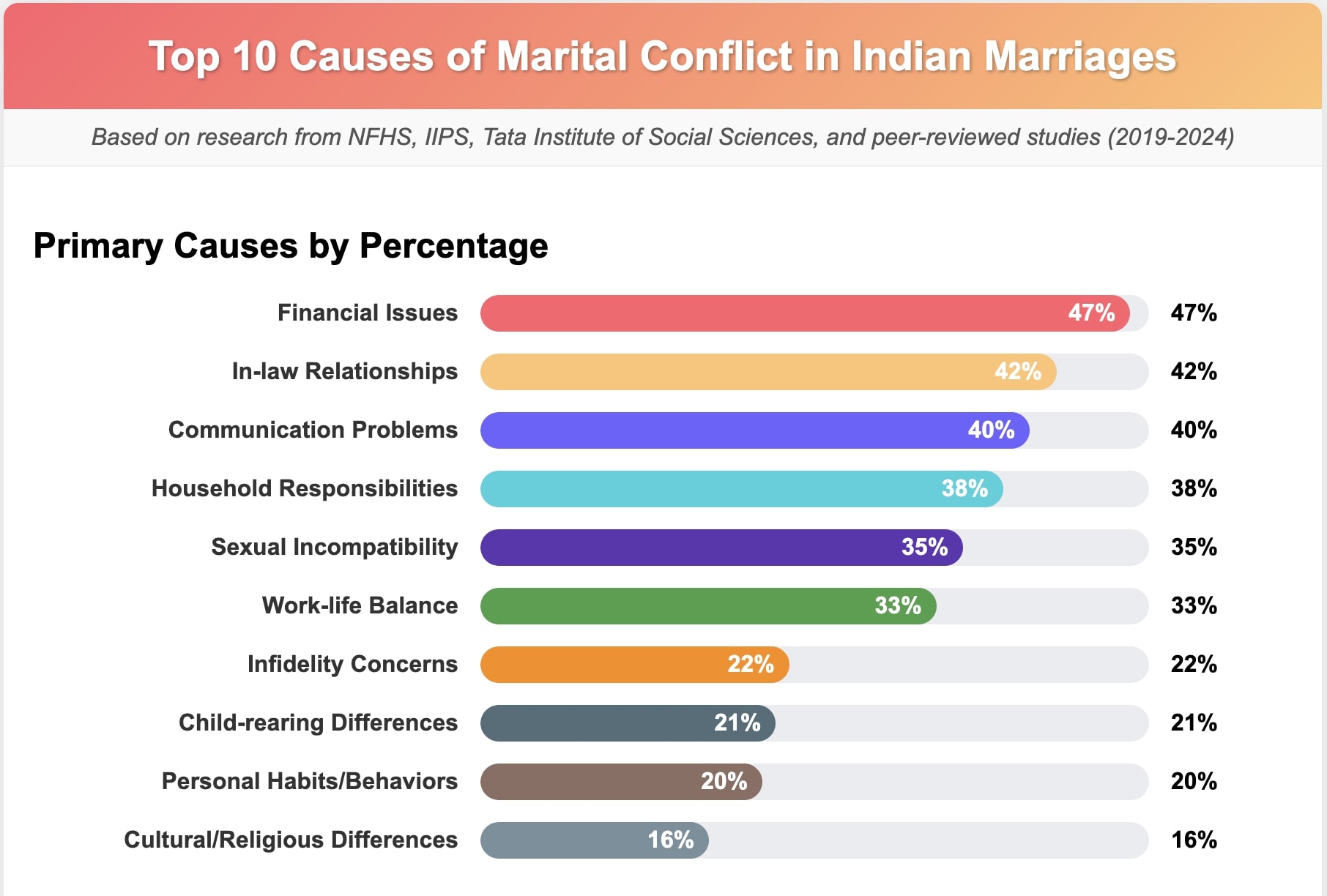
Understanding what's causing your relationship difficulties is half the battle. Here are some common issues modern Indian couples face:
- Communication concerns – You're talking but not really hearing each other. Or maybe you've stopped talking altogether about anything meaningful.
- Trust issues – Perhaps there's been an incident of infidelity, or maybe smaller breaches of trust have accumulated over time.
- In-law relationships - Couples often show concerns about in-law interference in decision-making, causing issues within the relationship.
- Financial disagreements – In today's world, financial stress can seriously impact relationships. Different spending habits or financial priorities can create ongoing tension.
- Intimacy problems – This isn't just about physical intimacy (though that's important too). Emotional intimacy often suffers first when couples grow apart.
- Extended family dynamics – A challenge particularly relevant in India, where joint families or close family ties can introduce complex relationship dynamics.
- Work-life imbalance – With demanding careers and long commutes in Indian cities, many couples struggle to prioritise their relationship amid competing demands.
- Cultural and value differences – Couples may discover they have different values or expectations about marriage.
- Constant criticism and defensiveness – If conversations regularly devolve into attacking and defending, you're stuck in an unhealthy pattern.
- Emotional withdrawal – One or both partners have "checked out" emotionally.
- Major life transitions are creating strain – Whether it's having children, career changes, or health challenges.

Feeling Disconnected in your Relationship?
Take the Amaha assessment to know if it is a temporary relationship bump or there are deeper concerns.
Steps To Connect Better With Your Partner Through Counselling
Key Relationship Skills a Counsellor Helps You Develop
Relationship counselling isn't just about solving current problems; it's about building skills that strengthen your relationship for years to come. A skilled relationship counsellor will help you develop:
Emotional regulation skills – Learn to manage strong emotions during disagreements instead of letting them escalate conflicts. This is especially helpful for couples where one or both partners struggle with anger or shutting down during arguments.
Effective communication patterns – Beyond basic listening, counsellors teach specific techniques like "I" statements, reflection, validation, and how to express difficult feelings without blame.
Conflict resolution – Arguments are inevitable, but how you argue matters enormously. Counsellors provide step-by-step frameworks for resolving disagreements constructively, helping you move from "winning" arguments to actually solving problems together.
Boundary-setting practices – Many relationship problems in Indian families stem from boundary issues, whether with in-laws, work demands, or between partners. Counsellors help you identify healthy boundaries and communicate them respectfully.
Empathy and perspective-taking – Understanding your partner's world view—even when you disagree—is crucial for intimacy. Counsellors use specific exercises to help you truly see situations through your partner's eyes.
Vulnerability and trust-building – For many couples, especially those from backgrounds where emotional expression wasn't modelled, learning to be appropriately vulnerable is challenging but essential. Counsellors create safe spaces to practice this skill.
Negotiation and compromise strategies – From daily decisions to major life choices, couples need effective ways to make decisions together. Relationship counsellors teach specific negotiation techniques that honour both partners' needs.
Appreciation practices – Simple but powerful habits of noticing and expressing gratitude for your partner can counteract negativity. Many couples are surprisedby how structured appreciation exercises change their perception of the relationship.
Intimacy-building techniques – Beyond physical intimacy, counsellors help with emotional and intellectual connection through specific bonding exercises tailored to your relationship's unique needs.
These skills don't just improve your relationship—they often enhance all your interpersonal connections, from friendships to work relationships to family dynamics. Many couples report that these tools become life skills they use everywhere.
Try-at-Home Connection Building Relationship Practices
While professional counselling provides expert guidance, there are simple practices you can start today to improve your relationship. These complement professional help rather than replace it.
Daily Communication Rituals – Set aside 15 minutes for uninterrupted sharing about your day. Simply listen without solving problems. This prevents the emotional distance that many Indian couples experience after years together.
Appreciation Practice – Share one specific thing you value about your partner daily. Feeling acknowledged prevents resentment and builds goodwill that helps during conflicts.
Conflict Time-Out – Agree on a pause signal when discussions heat up. Resume only after cooling off. This prevents regrettable words that cause lasting damage.
Connection Builders – Regularly revisit happy memories through photos or recreate elements of your early relationship. These nostalgic activities reignite positive feelings that may have become buried under daily responsibilities.
Shared Goals – Schedule quarterly conversations about your future vision together. This prevents the drift many couples experience when individual paths diverge unnoticed.
Start with just one practice that resonates with your situation. Consistency matters more than perfection, and approaching these activities with playfulness rather than pressure makes them more effective.
Finding The Right Relationship Counsellor In India
The relationship between you and your counsellor matters enormously. You need someone you both feel comfortable with.
How to Choose a Relationship or Marriage Counsellor
Look for:
- Professional qualifications and experience
- Specialisation in relationship issues
- A counselling style that suits both partners
- Someone who understands relevant cultural nuances
- Practical location and scheduling options
In larger Indian cities like Mumbai, Delhi, Bangalore, and Chennai, you'll find numerous qualified professionals. In smaller towns, options might be more limited, but many counsellors now offer online sessions, making quality help accessible regardless of location.
Ask potential counsellors about their approach, experience, session structure, and fees. Most offer an initial consultation where you can gauge if they're the right fit.
In some cases, a relationship counsellor may recommend parallel individual therapy to work through concerns rooted in personal experiences; when this happens, it’s important to seek support from a separate individual therapist rather than using the couple’s counsellor for individual sessions.
The Journey Of Healing Together
Relationship counselling isn't a quick fix. It's a journey, sometimes challenging, but potentially transformative.
Many couples find that the skills they learn extend far beyond saving their relationship. They become better communicators, more empathetic listeners, and more emotionally intelligent individuals overall.
Whether you're navigating serious issues or simply want to strengthen your bond, relationship counselling offers valuable tools to help you create the connection you both deserve.

Ready to Reconnect With Your Partner?
A coach call can help you understand relationship counselling, clarify your concerns, and explore how professional support can help you reconnect and communicate better.
Frequently Asked Questions:
What is the difference between relationship counselling and marriage counselling?
While the terms are often used interchangeably, there are subtle differences. Relationship counselling is a broader term that applies to any romantic partnership, whether married or not. Marriage counselling specifically focuses on married couples and may address unique aspects like legal commitments, religious contexts, and family dynamics that come with matrimony. In India, marriage counselling often considers cultural traditions, joint family dynamics, and community expectations that might not apply to unmarried couples. However, the core therapeutic techniques used in both types of counselling are largely similar, focusing on communication, conflict resolution, and emotional connection
How many sessions of relationship counselling do we need?
This varies widely depending on your specific challenges. Some couples see improvement in 5-8 sessions, while others benefit from longer-term support spanning several months. Most counsellors recommend starting with weekly sessions, then gradually reducing frequency as you develop new relationship skills and patterns.
Can relationship counselling save a marriage that seems beyond repair?
While no approach guarantees success, many relationships that seem "beyond saving" do improve with professional help. The key factors are both partners' willingness to participate honestly, take responsibility for their contributions to problems, and commit to making changes. Even in cases where reconciliation isn't possible, counselling can help couples separate more amicably.
Is online relationship counselling as effective as in-person sessions?
Research shows that online counselling can be just as effective as in-person therapy for many couples. It offers advantages like convenience, accessibility, and comfort of familiar surroundings. However, some couples benefit more from the structured environment of in-person sessions, particularly when tension is high. Many counsellors now offer both options.
Will a relationship counsellor take sides or tell us who is right?
A professional relationship counsellor never takes sides. Their role is not to determine who's "right" or "wrong" but to help both partners understand each other's perspectives and underlying needs. They focus on identifying unhealthy patterns in the relationship dynamic rather than assigning blame, creating a balanced environment where both partners feel heard and respected.