

Amaha / / / Relationship Compatibility: What It Actually Means and How to Think About It
ARTICLE | 4 MINS READ
Relationship Compatibility: What It Actually Means and How to Think About It
Published on
25th Aug 2026

Siddhi Hegde
M.Phil Clinical Psychology

A friend arguing with their partner for fifteen minutes over where to keep the pressure cooker isn't really arguing about the pressure cooker. It's a small, low-stakes window into how two people negotiate differences, which is closer to what relationship compatibility actually means than most people assume. There's no clinically validated test that can tell a couple with certainty whether they're compatible or whether their relationship will last, and it's worth being upfront about that before going any further. What research does offer is something more useful in practice: a clear understanding of what compatibility actually involves, and validated ways to measure related things like relationship satisfaction, which couples can use to understand their relationship rather than to grade it.
What Relationship Compatibility Actually Means
Relationship compatibility refers to how well two people function together emotionally, intellectually, and practically, sharing enough core values and communication rhythm to navigate life's demands as a team. It shows up in areas like communication style, life goals, conflict resolution, and daily lifestyle habits; differences here don't automatically doom a relationship, but they do shape how much friction a couple will need to work through, and about what. Compatibility is best understood as a description of how two specific people currently fit together, not a fixed trait either person has or lacks on their own.
Compatibility vs Love: Why They're Not the Same Thing
Love is the emotional connection and attraction two people feel toward each other. Compatibility is a separate, more practical question, whether two people's lifestyles, values, and ways of handling daily life and conflict actually align.
It's entirely possible to love someone deeply while struggling daily over incompatible approaches to family involvement, career priorities, or money, which is exactly why the two are worth thinking about separately rather than assuming one guarantees the other.

Check how Reliable and Compatible your partner is?
Take Amaha's Relationship Compatibility tests for Couples
The Psychology Behind Relationship Compatibility: Attachment Style and Personality
Much of the psychology behind how couples experience compatibility draws on attachment theory, the framework describing how early relationships shape a person's patterns of closeness, trust, and response to conflict in adult relationships, generally categorised as secure, anxious, or avoidant. Understanding a partner's attachment style helps explain reactions that might otherwise seem confusing, why one partner withdraws under stress while the other seeks closer contact, for instance, and gives couples a shared vocabulary for patterns that would otherwise just look like incompatibility. Personality differences function similarly. Two people don't need matching personalities to work well together, but understanding where their patterns differ helps explain friction that might otherwise be misread as a deeper mismatch.
What Actually Predicts Relationship Stability, and Where the Research Gets Overstated
Psychologist John Gottman's decades of observational research on couples identified four specific conflict patterns, criticism, contempt, defensiveness, and stonewalling, often referred to together as the "Four Horsemen," that were associated with relationship breakdown, and his research consistently found that couples who displayed these patterns but still made genuine attempts to repair conflict, de-escalating or reconnecting during an argument, tended to remain stable over time.
One often-repeated claim is that this research can predict divorce with 90 to 94% accuracy. That number is worth taking with caution. It came from testing the model on the same couples used to build it in the first place, not on new couples whose outcomes were unknown, and when other researchers tried the model on fresh data, it didn't hold up nearly as well. The Four Horsemen and the importance of repairing after conflict are still genuinely well-supported findings. The precise prediction number just isn't one of them.
Key Areas Where Compatibility Shows Up: Communication, Values, Conflict, and Lifestyle
A few recurring areas tend to be where compatibility, or its absence, becomes most apparent in daily life.
- Communication style covers whether both partners prefer direct conversation or tend to read between the lines.
- Life goals and values cover long-term questions, career ambitions, family planning, and what each partner considers a meaningful life.
- Conflict resolution examines whether partners need space to cool down or prefer resolving disagreements immediately.
- Family dynamics, particularly relevant in Indian relationships, covers how involved each partner wants their families to be in shared decisions.
- Financial habits, emotional needs around reassurance versus independence, and lifestyle rhythms round this out.
None of these areas produce a pass or fail result on their own; they simply tell a couple where they'll need more active communication and where things will likely feel easier.

Build Stronger Relationship Skills
Facing challenges with boundaries or connection? Learn skills to improve your relationships.
Compatibility in Indian Relationships: Family Involvement, Kundali Matching, and Modern Expectations
Traditional compatibility assessment in Indian families has often centred on kundali matching, educational background, and family standing, a framework still influential even as younger couples increasingly weigh emotional and practical compatibility alongside it. Indian relationships also involve a wider circle than the couple alone, extended family, in-laws, and community expectations regularly factor into decisions that would be considered private in other contexts. This means thinking through compatibility for Indian couples benefits from including areas a Western framework might not prioritise as heavily, joint family living arrangements, festival and religious practice, and expectations around supporting parents, since ignoring these can leave a couple who feel compatible in principle facing ongoing friction in practice.
This wider circle can shape a relationship's day-to-day experience considerably, sometimes in supportive ways and sometimes in ways that strain the couple directly. Family involvement often brings genuine practical and emotional support, shared caregiving, financial backing, a sense of not navigating major decisions alone, that couples in more individualistic settings don't always have access to. At the same time, it can introduce friction that has little to do with the couple's own compatibility, disagreements over how much say parents should have in finances, parenting, or career decisions, or one partner feeling caught between a spouse's expectations and a parent's. Couples who are otherwise well matched can still experience real tension if they haven't discussed where family involvement is welcome and where it isn't, which is why compatibility conversations in Indian relationships often need to extend beyond the two partners to include some explicit agreement on where the boundary with extended family sits.
What Clinical Scales Actually Measure: Satisfaction, Not Compatibility
The tools therapists and researchers actually use in this space don't claim to measure compatibility as a fixed, predictive quality. They measure multiple areas of a relationship, capturing how a couple is currently doing rather than forecasting how they'll do in future.
The Dyadic Adjustment Scale, developed by Spanier in 1976 and still widely used in both clinical and research settings, assesses consensus, satisfaction, cohesion, and affection between partners.
The Couples Satisfaction Index, developed more recently, measures similar ground with strong statistical precision and is commonly used in couples therapy to track whether an intervention is actually helping.
The Gottman Relationship Checkup, built on Gottman's broader research, assesses communication patterns and areas of strength or friction, again as a snapshot of current functioning rather than a prediction of outcome.
All of these are useful for understanding a relationship as it currently stands, and for tracking change over time in therapy, which is a considerably more grounded use than treating any single score as a verdict on whether two people belong together.
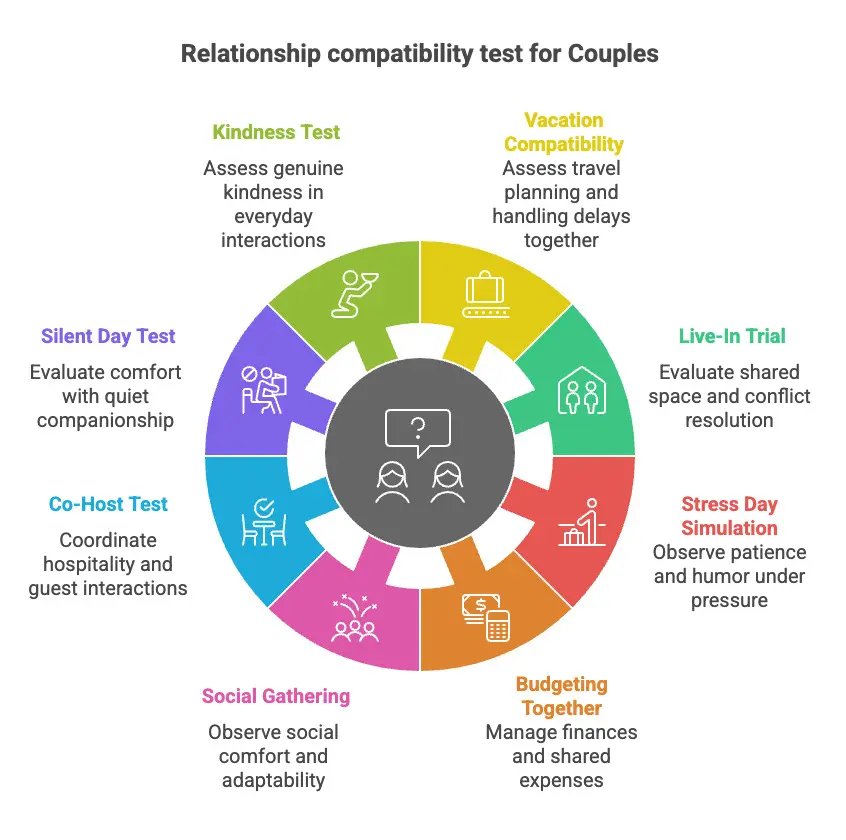
Everyday Ways Couples Notice Compatibility, or Its Absence
Compatibility often becomes clearer through shared experiences that create mild, real-world stress rather than through any formal assessment, planning a short trip together and noticing how decisions get made, managing a joint budget for a month, or simply spending a day together in shared but separate activities to see how comfortable quiet companionship feels. These moments reveal patterns that a questionnaire alone often misses, since they involve actual behaviour under mild pressure rather than self-reported preference.
Signs of Genuine Compatibility vs Surface-Level Similarity
Genuine compatibility tends to show up as a couple's ability to disagree without the disagreement threatening the relationship itself, consistent with Gottman's finding that successful repair after conflict, not the absence of conflict, is what's associated with long-term stability. Surface-level similarity, shared hobbies, similar backgrounds, overlapping social circles, can feel like compatibility early on without necessarily reflecting alignment on the deeper areas, values, conflict style, and family expectations, that tend to matter more once daily life and long-term decisions are involved.
Building Compatibility Over Time With Couples Therapy
Compatibility isn't fixed, and treating it as something to establish once and settle misses how relationships actually work. Dating couples, engaged couples navigating family and wedding pressure, and married couples adjusting to new life stages all continue negotiating compatibility throughout the relationship, not just at the outset. Couples therapy supports this ongoing process directly, through thorough history taking and using validated tools like the Dyadic Adjustment Scale or the Gottman Relationship Checkup to understand where a couple's friction actually sits, then helping them build the communication and repair skills that Gottman's research does robustly support as protective for a relationship's stability. For couples at any stage, this is a considerably more useful way to engage with compatibility than looking for a single test to settle the question, since the honest answer is that no such test exists, and building compatibility is an ongoing practice rather than a one-time result.

Talk to a Relationship Expert
Compatibility tests are a start. A relationship coach can help you and your partner grow, overcome challenges, and strengthen your bond.
Frequently Asked Questions
Are compatibility tests accurate for predicting marriage success?
Compatibility tests provide valuable insights but aren't fortune tellers. Studies show couples with higher compatibility scores report 40% fewer major conflicts, but success depends more on how you use these insights to improve communication and understanding. Think of them as relationship GPS - helpful guidance, not guaranteed destinations.
What's the difference between love and compatibility in Indian relationships?
Love is the emotional connection and attraction you feel, while compatibility is about how well your lifestyles, values, and goals align practically. In Indian marriages, both matter enormously. You can love someone deeply but struggle daily if you're incompatible on core issues like family involvement, career priorities, or financial management.
Should we take compatibility tests before or after getting engaged?
Ideally, take them during serious dating when you're considering a long-term commitment. This timing allows you to address any concerns openly without family pressure or wedding planning stress. However, it's never too late - even engaged or married couples benefit from understanding their compatibility patterns better.
How important is family compatibility in Indian relationship tests?
Extremely important! Indian relationships involve extended families significantly more than Western relationships. Good compatibility tests for Indian couples include questions about joint family dynamics, festival celebrations, in-law relationships, and balancing individual vs. family needs. Ignoring family compatibility can create ongoing stress even in otherwise strong relationships.
What if our compatibility test results show major differences?
Don't panic! Differences aren't automatically deal-breakers. Focus on whether your core values align and if you both willingly want to work on the differences. Some differences (like introversion vs. extroversion) can actually strengthen relationships. Others (like vastly different life goals) might need serious discussion and compromise. Consider couples counseling to navigate significant differences constructively.